Heath-leaved Banksia
Banksia ericifolia
Heath-leaved Banksia (Banksia ericifolia) is a bushy shrub or small tree from the coast of New South Wales, where it grows in heath, dry forest and woodland. Its large orange flower spikes appear in autumn and winter, and they attract honeyeaters. It suits a sunny garden with well-drained, sandy soil.
- Sun
- Full sun or part shade
- Soil
- Acid, sandy, well drained
- Water
- Good drainage, tolerates some damp
- Size
- About 4 m (up to 6 m wild)
- Flowers
- Orange to red-orange, Apr–Aug
- Frost
- Tolerates frost
Photo: Bryce Watts-Parker, CC BY, via iNaturalist
- Photo: Toby Jin, CC BY, via iNaturalist
- Photo: Roger Yandle, CC0, via iNaturalist
- Photo: Thomas Mesaglio, CC BY, via iNaturalist
Growing it
Plant it in full sun or semi-shade, in light to medium acid soil that drains well. Sandy gardens suit it, and it also grows on heavier clay and moist soils, possibly with less vigour. Avoid fertilisers high in phosphorus. It spreads widely, so allow room.
The plant has no lignotuber, a woody root base that lets some shrubs regrow after fire or cutting, so it regenerates from seed rather than resprouting. Prune after flowering, or when picking cut flowers; regular light pruning gives a denser shape.
It can be grown from seed or cuttings, and seed propagation is reliable. Plants can take up to eight years to begin flowering, so be patient. The seed is stored in woody cones for many years and released by the heat of fire.
What it looks like
Heath-leaved Banksia is a bushy shrub or small tree with grey-brown, slightly corky bark. Its leaves are narrow and linear, which means long and thin with straight sides. They are about 1 to 2 cm long, nearly stalkless, and their edges roll under. The underside is hairy.
The flower spikes are 10 to 20 cm long. Each flower has a golden-brown perianth, which is the tube-like outer part, often tinged mauve near the base. The style, the slender part that carries the pollen, is gold to orange-red and hooked near its tip.
The fruit is a woody cone holding many follicles, which are small seed pods about 15 to 20 mm long. Many of these stay closed until fire opens them.
For wildlife
The flower spikes attract honeyeaters and other birds, and the plant is regarded as one of the best for drawing in honey-eating birds. The flowers appear in autumn and winter.
Threatened wildlife that uses it
Flowers visited by
- Eastern Pygmy-possumunverifiedVulnerable in NSW
- Grey-headed Flying-foxunverifiedVulnerable
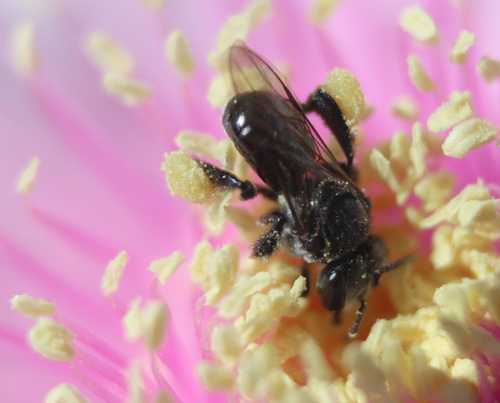 Charcoal Stingless Bee
- Red Wattlebirdunverified
- Eastern Spinebillunverified
- Little Wattlebirdunverified
- New Holland Honeyeaterunverified
Eaten by
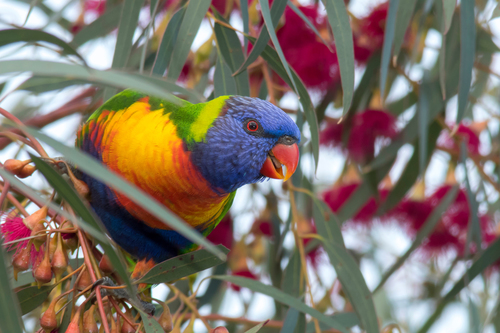
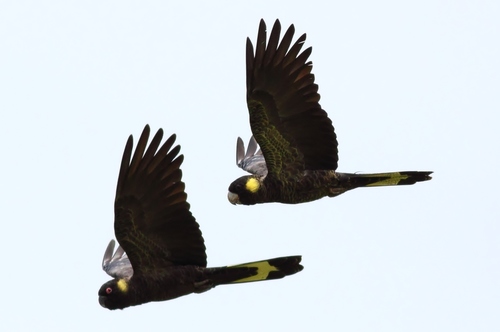
Also recorded with
Where it belongs
It grows naturally along the coast and nearby ranges of New South Wales, from Jervis Bay north to the Queensland border. It is found in heath, dry sclerophyll forest and woodland, mostly on sand and sandstone.
Suburbs it belongs in include:
Related plants
Sources
- Banksia ericifolia, PlantNET, NSW Flora Online, Royal Botanic Garden Sydney
- Banksia ericifolia (Heath-leaved banksia), Australian Native Plants Society (ANPSA)
- Banksia ericifolia, Australian Plants resources
- Native range: Australian Plant Census and Alien Flora of Australia. Wildlife links: GloBI and the studies cited on each animal page. All sources