Hill Banksia
Banksia spinulosa
Hill Banksia (Banksia spinulosa), also called Hairpin Banksia, is a multi-stemmed shrub of heath, dry forest and woodland in eastern Australia. Its large autumn and winter flower spikes are a nectar source for honeyeaters, and it suits a sunny, well-drained garden.
- Sun
- Full sun
- Soil
- Well-drained sand or loam
- Water
- Avoid waterlogging
- Size
- 1–3 m tall
- Flowers
- Orange-yellow, Apr–Aug
Photo: Bryce Watts-Parker, CC BY, via iNaturalist
- Photo: ian_mcallan, CC BY, via iNaturalist
- Photo: ronavery, CC BY, via iNaturalist
- Photo: Bruce Cathie, CC BY, via iNaturalist
Growing it
Plant it in a sunny spot with well-drained sandy or loamy soil. It seldom grows on heavy clay, so improve drainage if your soil holds water, and planting on a slight slope helps. Root-rotting fungi are a risk in waterlogged ground. Avoid high-phosphorus fertiliser, as members of the banksia family (Proteaceae) are generally sensitive to it.
Prune after flowering, or when cutting flowers; regular pruning gives a denser shape. The plant has a lignotuber, a woody swelling at the base that lets it resprout after fire.
Seed is reliable and not too difficult to grow. Named cultivars do not come true from seed, so they are grown from cuttings. Garden plants are slow-growing and may reach about 2 m, so allow room.
What it looks like
Hill Banksia has grey-brown bark and several stems. Its narrow leaves are 3 to 10 cm long and 1 to 10 mm wide, with edges that roll under, and the upper part of the leaf is usually toothed. The foliage is not painful to touch, despite the species name.
The flower spikes are 6 to 15 cm long and made up of many small flowers. The petal-like parts (the perianth) are yellow or golden, and the styles, the long threads that carry the pollen, are hooked near the tip and either yellow or dark red to purple-black, giving the spikes their two-toned look.
The fruit is a crowded cluster of woody pods (follicles), 10 to 24 mm long, which open after fire or sometimes on their own.
For wildlife
The flowers are an important autumn nectar source when little else is blooming. Honeyeaters such as the eastern spinebill and white-eared and yellow-tufted honeyeaters visit them, and native bees have been seen on the flowers too.
Small mammals also take nectar. Pygmy-possums, sugar gliders, antechinus and bush rats have been recorded at the flowers.
Threatened wildlife that uses it
Flowers visited by
- Grey-headed Flying-foxunverifiedVulnerable
- Eastern Pygmy-possumunverifiedVulnerable in NSW
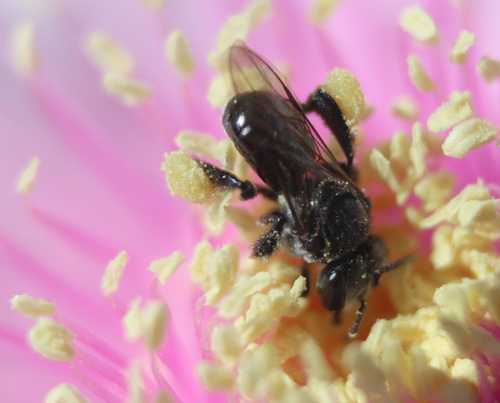 Charcoal Stingless Bee
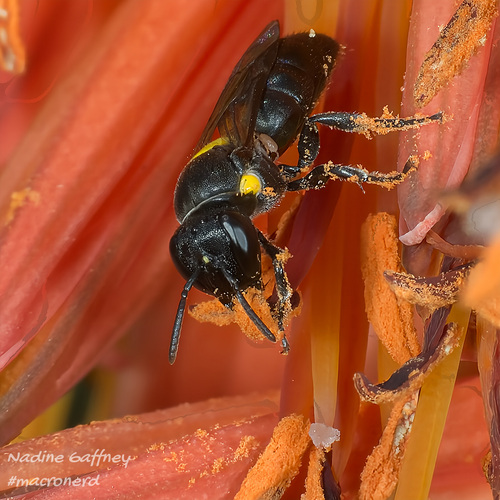 Dark-headed Dimorphic-Masked Bee
- Little Wattlebirdunverified
- New Holland Honeyeaterunverified
- Eastern Spinebillunverified
- Red Wattlebirdunverified
Eaten by
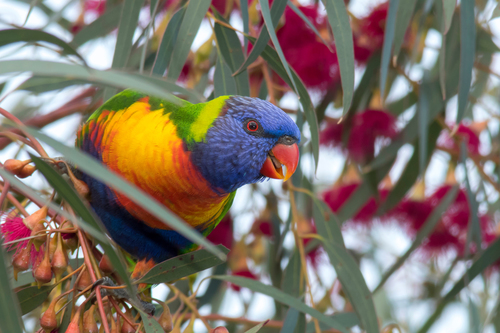
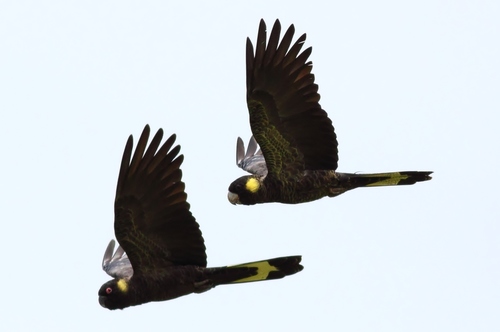
Also recorded with
Where it belongs
It is native to coastal and mountain areas of New South Wales, southern Queensland and eastern Victoria, with scattered populations reaching north to the Atherton Tableland. It grows in heath, dry forest and woodland.
Suburbs it belongs in include:
Related plants
Sources
- Banksia spinulosa, NSW Flora Online, Royal Botanic Garden Sydney
- Banksia spinulosa, Australian Native Plants Society (ANPSA)
- Banksia spinulosa (Hairpin Banksia): growing notes, Australian Plants
- Banksia spinulosa, Wikipedia (wildlife and range, cross-checked against the sources above)
- Native range: Australian Plant Census and Alien Flora of Australia. Wildlife links: GloBI and the studies cited on each animal page. All sources