Rusty Banksia
Banksia oblongifolia
Rusty Banksia (Banksia oblongifolia) is a several-stemmed shrub of the eastern coast, found from the New South Wales south coast to central Queensland. It is also called Fern-leaved Banksia, and its new growth is covered in rusty-brown fur. It suits sandy gardens and is good for attracting honeyeaters.
- Sun
- Full sun or dappled shade
- Soil
- Sandy, well drained
- Water
- Extra water in dry spells
- Size
- 1–3 m tall
- Flowers
- Pale yellow, Mar–Jun
Photo: ian_mcallan, CC BY, via iNaturalist
- Photo: Sofia Zvolanek, CC BY, via iNaturalist
- Photo: Petra Holland, CC BY, via iNaturalist
- Photo: Billie, CC0, via iNaturalist
Growing it
Plant it in full sun or dappled shade, in sandy, well-drained soil. In the wild it grows mostly on sandstone and sandy ground, and it is very tolerant of coastal salt spray. Allow for good drainage. Once established it is hardy, but it comes from a summer-moist climate, so it benefits from extra water in dry spells. It is likely to be only moderately frost tolerant.
Banksias belong to the family Proteaceae, which is sensitive to phosphorus, so avoid high-phosphorus fertiliser.
Prune after flowering to keep the shrub compact. Seed is reliable and not difficult; the woody fruit may need fire or a drying-out period to open. Cuttings also work. After fire the plant regrows from a lignotuber, a woody swelling at the base that holds dormant buds.
What it looks like
Rusty Banksia is an open shrub with several stems and reddish to grey-brown bark that is smooth with small pores. The leaves are alternate, obovate to oblong (broadest towards the tip), 5 to 8 cm long and 15 to 20 mm wide. Their edges are usually toothed. The upper surface is olive to blue-green, mature leaves are white or pale green underneath, and new growth is brown-red and furry.
The flower spikes are 5 to 15 cm long. Each flower is pale yellow, and the buds are tinged grey-blue. The style, the slender part that carries the pollen-receiving tip, is cream and straight.
The fruit is a woody cluster of up to 80 follicles, which are dry seed pods that split along one seam. They are 10 to 18 mm long and velvety when young.
For wildlife
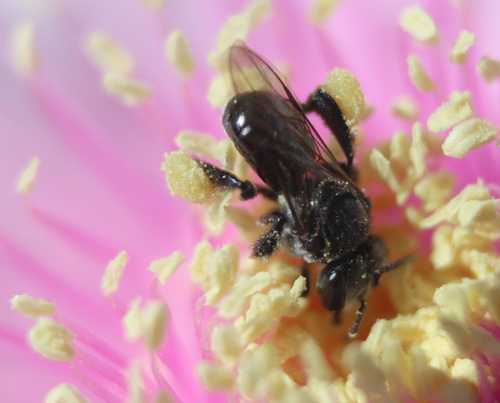
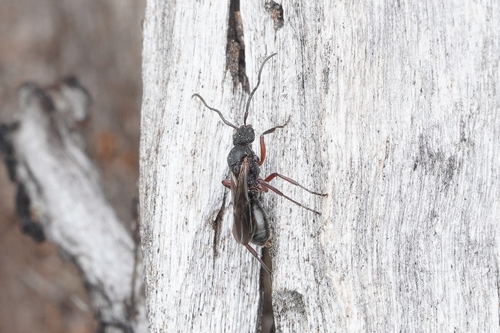
The flower spikes are a good nectar source for honeyeaters and other birds. Red Wattlebirds, New Holland Honeyeaters and Eastern Spinebills are among the birds recorded feeding on them. Honeybees and ants also visit the spikes.
Threatened wildlife that uses it
Flowers visited by
- Eastern Pygmy-possumunverifiedVulnerable in NSW
- Grey-headed Flying-foxunverifiedVulnerable
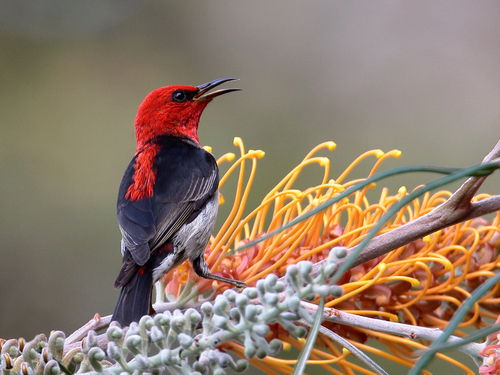 Scarlet Honeyeater
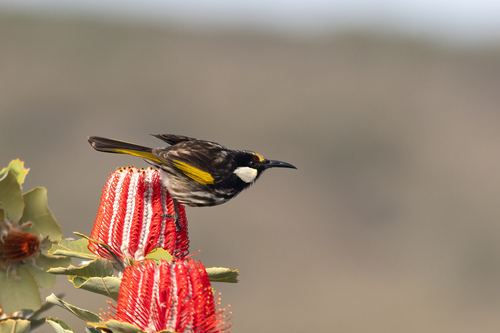 White-cheeked Honeyeater
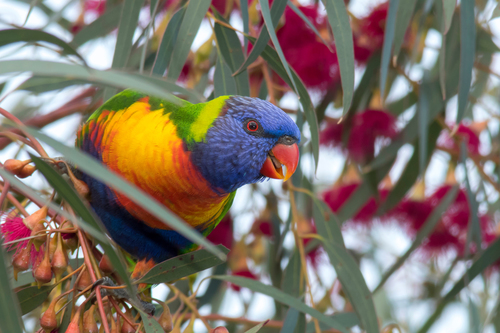 Rainbow Lorikeetunverified
- Red Wattlebirdunverified
- Eastern Spinebillunverified
- Little Wattlebirdunverified
- New Holland Honeyeaterunverified
Eaten by
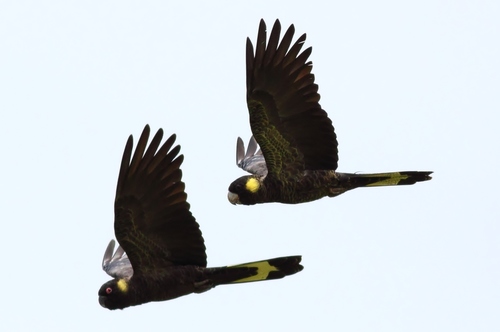
Where it belongs
Native to coastal New South Wales and Queensland, from about Ulladulla north to Rockhampton. It grows in dry sclerophyll forest and heath, mostly on sandy or sandstone soils.
Suburbs it belongs in include:
Related plants
Sources
- Banksia oblongifolia, NSW Flora Online (PlantNET), Royal Botanic Garden Sydney
- Banksia oblongifolia, Australian Native Plants Society (ANPSA)
- Banksia oblongifolia, Australian Plants resources
- Banksia oblongifolia, Wikipedia (common names, range and bird visitors)
- Native range: Australian Plant Census and Alien Flora of Australia. Wildlife links: GloBI and the studies cited on each animal page. All sources