Acorn Banksia
Banksia prionotes
Acorn Banksia (Banksia prionotes) is a tall shrub or small tree from the south-west of Western Australia. Its name comes from the partly opened flower spikes, which look like acorns. In a sunny, well-drained garden it is an excellent plant for honeyeaters, giving them nectar through autumn and winter.
- Sun
- Full sun to light shade
- Soil
- Well-drained sand or loam
- Water
- Dry once established
- Size
- 3–10 m tall
- Flowers
- Orange and cream, Feb–Aug
- Frost
- Tolerates moderate frost
Based on its natural habitat: little has been published on growing it.
Photo: Paul Prior, CC BY, via iNaturalist
- Photo: Chantel McWilliam, CC BY, via iNaturalist
- Photo: Carmy, CC BY-SA, via iNaturalist
- Photo: smathichong, CC BY, via iNaturalist
Growing it
Plant it in full sun or light shade, in soil that drains well. It suits dry-summer climates and is hard to keep going where summers are humid. It tolerates at least moderate frost.
Acorn Banksia has no lignotuber, the woody root base that lets some banksias regrow after fire. After a fire it can only come back from seed, so don't cut it back hard. Prune lightly, and not below the green foliage, or the plant becomes straggly with age.
The seed is easy to grow, and it is the usual way to raise new plants. Cuttings can be hard to strike.
What it looks like
Acorn Banksia grows as a tall shrub or small tree. Near Perth it can reach about 10 m, while near Eneabba it stays shorter and more spreading, at about 4 m.
The leaves are alternate, hairy and deeply lobed, 15 to 28 cm long. The flowers open cream and turn orange as they age, packed into cylindrical spikes at the branch ends. The spikes look like acorns while still partly closed. The fruit is a hairy follicle, a dry seed pod, 14 to 20 mm long.
For wildlife
Nectar-feeding birds, mainly honeyeaters, are the main visitors to the flowers. These include the New Holland Honeyeater and the Red Wattlebird. Birds, not insects, are the effective pollinators. In the Avon Wheatbelt it is the only nectar source for honeyeaters during a critical time of year.
Threatened wildlife that uses it
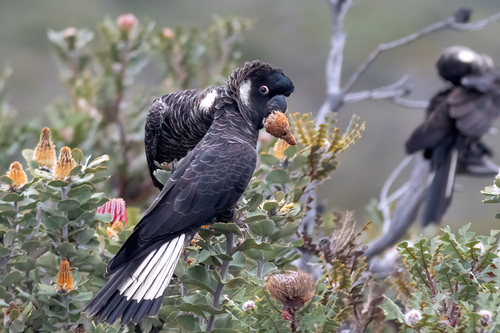
Flowers visited by
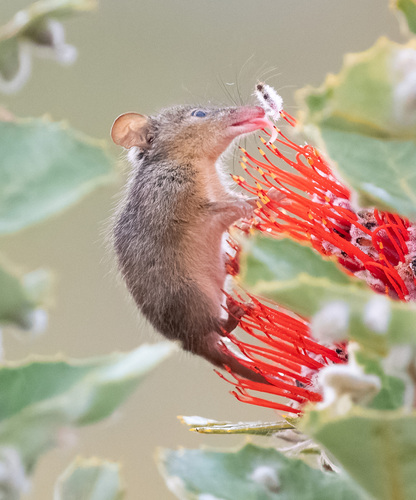
Eaten by
Where it belongs
It is native to south-western Western Australia, from Shark Bay south to Kojonup, and grows on sandplains and dunes in white or yellow sand, sandy loam, clay and laterite. Western Australia lists it as not threatened.
Suburbs it belongs in include:
Related plants
Sources
- Banksia prionotes Lindl., Acorn Banksia, Taxon Profile, FloraBase, WA Department of Biodiversity, Conservation and Attractions
- Banksia prionotes, Australian Native Plants Society (ANPSA)
- Banksia prionotes, Wikipedia
- Native range: Australian Plant Census and Alien Flora of Australia. Wildlife links: GloBI and the studies cited on each animal page. All sources