Bull Banksia
Banksia grandis
Bull Banksia (Banksia grandis) is a tree or large shrub from the south-west of Western Australia. Its big, deeply cut leaves are the most striking feature, and it carries large pale yellow flower cones from spring into summer. It suits a sunny garden with sandy soil and a dry summer.
- Sun
- Full sun or part shade
- Soil
- Sandy, well-drained
- Water
- Suits dry summers
- Size
- 1.5–10 m tall
- Flowers
- Pale yellow, Sep–Jan
- Frost
- Moderately frost hardy
Photo: Carmy, CC BY-SA, via iNaturalist
- Photo: Hugo Innes, CC BY, via iNaturalist
- Photo: smathichong, CC BY, via iNaturalist
- Photo: Em Lamond, CC BY, via iNaturalist
Growing it
Plant it in full sun or part shade, in sandy, well-drained soil. It suits areas with a dry summer and can be difficult in humid areas. It can also be grown in a large container.
Seed germinates reliably without pre-treatment, which makes it the simplest way to raise new plants. Cuttings can be struck but are slow, and success is well below 100 per cent.
Bull Banksia has a lignotuber, a woody swelling at the base of the stem that holds buds. After fire destroys the upper plant it can regrow from the lignotuber, or from seed.
What it looks like
Bull Banksia grows as a tree or shrub, usually up to about 10 m tall, though it is often much smaller in exposed coastal sites. The leaves are very large, about 14 to 31 cm long and 7 to 13 cm wide. Each is pinnately divided, meaning cut into 10 to 12 lobes down each side of a central midrib, which gives the foliage its bold, toothed look.
The flower cones are large, pale yellow and woolly, and appear from September to January. The species name grandis means large, and refers to the leaves.
For wildlife
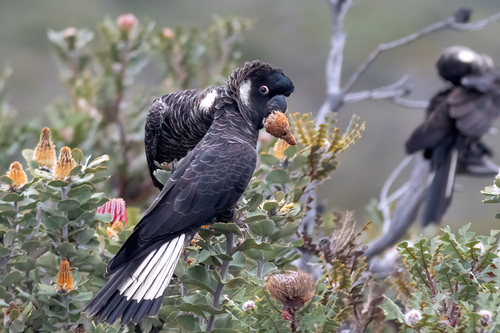
Carnaby's Black-Cockatoo, an endangered bird of the south-west, eats seed from banksias and other members of the Proteaceae family, along with seed from Marri and Jarrah nuts. It cuts seed-bearing cones from the tree with its bill, holds the food with one foot and strips out the seed. Planting banksias such as this one adds to the food available where the bird lives.
Threatened wildlife that uses it
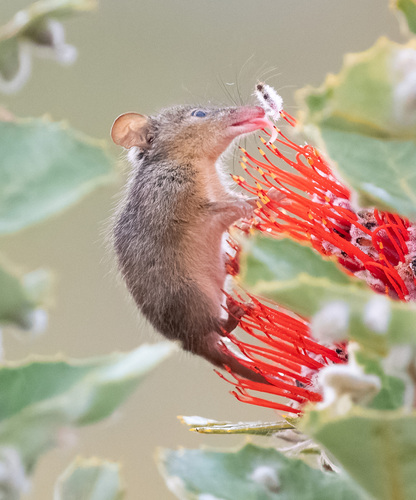
Flowers visited by
Eaten by
Where it belongs
It grows on white or grey sand and laterite on the Swan Coastal Plain and the Darling Scarp, from Jurien Bay to Bremer Bay and inland to Katanning. It is native only to Western Australia and is listed as not threatened.
Suburbs it belongs in include:
Related plants
Sources
- Banksia grandis Willd., Bull Banksia, FloraBase, WA Department of Biodiversity, Conservation and Attractions
- Bull banksia (Banksia grandis), Australian Native Plant Society (ANPSA)
- Banksia grandis, Friends of Queen's Park Bushland
- Bull Banksia, Whiteman Park
- Carnaby's Black-Cockatoo, BirdLife Australia
- Native range: Australian Plant Census and Alien Flora of Australia. Wildlife links: GloBI and the studies cited on each animal page. All sources